
Prey (Four Movement Suite)
For electronics, chamber orchestra, electric guitar, & BAKUDI SCREAM
suggested listening:
(0:00-2:05) – you on, god?
(5:20- 6:50) – Greed/Masters
(11:40- 14:50) BrownApe.wmd
(16:15- 17:28) The Conquest (ft. GW MAXXED)
Prey marks the completion of a multi-year project commissioned by the Matt Marks Impact Fund for the chamber orchestra Alarm Will Sound. The work was written over five years through a recursive process of improvisation, recording, and re-sampling of both the ensemble and my own solo work. The following is a four movement excerpt of what is a 10 movement, 40 minute long performance piece, which can be listened to here: https://bakudi-scream.bandcamp.com/album/prey
Prey is a confrontation of South Asian and European imperial legacies. The work attempts to compress the distance between their respective histories to highlight continuums and reverberations of violence, as well as possible etymologies. It does so by engaging with the languages of faith, worship, and ritual, yet mostly through sounds, from both heritages, that are superficially secular. Within that secularity however lies appeals to higher powers or confrontations with our limits of personal understanding, all of which create vacuums for the assertion of authority, control, and manipulation.
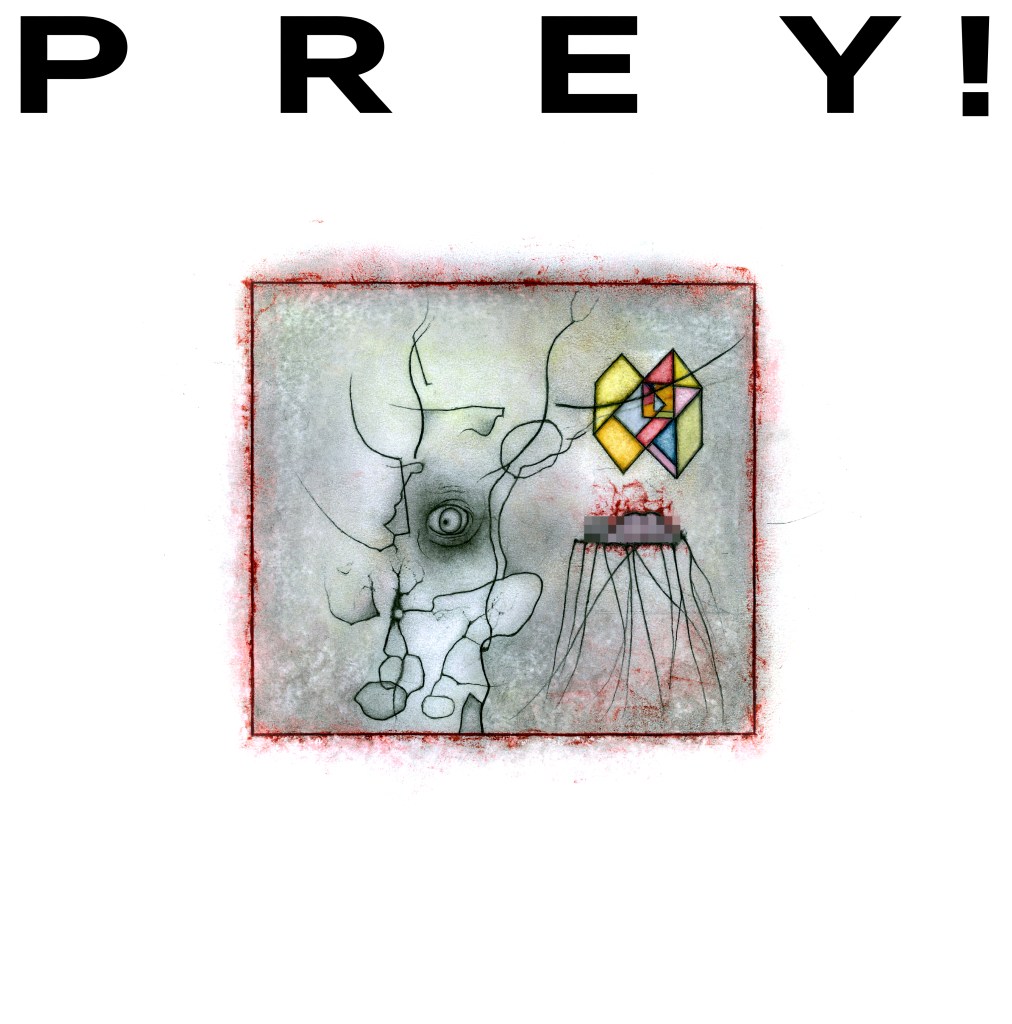
Prey (Suite) Cover Page
Juxtaposition becomes the essential mechanic in exposing those forces. However in Prey, juxtaposition can occur on global scales. Shifting between the formal trappings of industrial punk, dhol tasha, Christian rock, dub, orchestral music, and hip hop, the work employs genre as a supercharging of micro-overlays. Histories extending from each genre become part of a “treated” perspective on the sounds I choose to embed within them, creating what I hope to be a layered depth of field on a South Asian and diaspora identity.

As a performance experience, Prey concentrates the overlays into the BAKUDI SCREAM cyborg. Dressed in a full-body suit and mask, metallic and electronically wired, I perform ten rituals that implicate the audience and myself in different dynamics. The costume, consisting of a large red “searchlight” that is affixed inside a backpack, guides me through the audience. At times, I strike my manjira while amongst them, a trigger that is electronically augmented to play samples or generative data. At others, I ask the audience questions and dance with them, dragging my light across the ground as it flickers like a faint heart beat. However throughout these rituals, a sense of danger is maintained; the audience, at any point, may be thrown into direct confrontation with me, spotlighted by my light or pushed into contact with my body. This often has the audience switching between the roles of witness and participant, responding to a “higher power” that could snap back at any moment.
The first piece for this suite is you on, god? (0:00), the third movement of Prey. This movement introduces the essential cultural dichotomy of the work. Orchestral, choral, dhol, and vocal acapellas overlay in a semi-improvised form before breaking into an an accelerated dhol and choir duet. Across this transition, sonic overlays shift from functionally juxtapositional to homogenized, as if trying to push their liturgical, political, or expressive histories together. This process is punctuated by a Kanye West acapella: “Lord and Saviour I replied, i’mma ride, that’s on god” from his record “JESUS IS KING.”
Greed/Masters(4:20) resamples text from two culturally disparate songs, Fugazi’s “Greed” and Anirudh Ravichander’s “Vaathi Raid.” “Greed” speaks plainly to the exploitative nature of a higher power; however “Vaathi Raid” is a song sequenced to an action set piece of the 2020 Tollywood film, Master. In that film, “Vaathi Raid” (which translates to master’s raid) cues a sequence for the film’s protagonist, a school teacher (addressed in Tamil as vaathi, or master) as he goes on a vengeful attack to protect his students. In an isolated context, the translation of master’s raid suggests numerous historical and colonial implications, but within the context of Tollywood cinema, the lyrics glorifying the singular action hero reflect an endemic reality. In attempt to critique the South Asian obsession with savior types, I frame these two songs against each other, housing them within a post-hardcore vision of dhol tasha, a South Asian marching tradition with military ties.
In BrownApe.wmd (09:56), the framing narrows to a single song – “Fable of the Brown Ape” by Nick Cave and the Bad Seeds. The lyrics of the original song are more abstractly presented, telling the story of a farmer, who upon seeing a serpent and a “brown ape” in his barn, decides to capture and care for them until an angry mob discovers his act and kills the snake, freeing the ape. Loosely inspired from an Aesop fable (among other Asian folktales), the original lyrics speak to pleasing a corrupt power and perhaps Cave’s own relationship to faith. In my composition, all the lyrics are removed aside from one: “and the brown ape clanking a heavy chain,” which appears as a loop only at the end of the movement. The racialization of the ape was interesting to consider given that I’m a brown man, who in the past, has been described like a monkey given my “excess body hair.”
In BrownApe.wmd, lyrics are traded in for insistence. The central beat is a dub-ified version of the original groove of the song and prominently features members of Alarm Will Sound in a structured improvisation. Echoes of bansuri flutes, feedbacked multiphonics, and the blues blossoms into “praise break” moments that pull the sound of classic rock into the dialogue of heritage. This culminates in a competing improvisation between the electric guitar and flute, both drawing from respective traditions of classic rock and hindustani bansuri. Occasional interjections of Del The Funky Homosapien comments on the nature of that interaction, framing it as rhythm that is owned: “you either have it or you don’t.”
The Conquest (ft. GW MAXXED) (14:52) functions as a formal interlude, using the song form to embody the sound of Christian rock and midwest emo. As a sound so deeply tied to an American nostalgia, I was curious as to what existing within that as an Indian man would imply. What memories do I revisit? And how do those memories fit against what “American nostalgia” is? It then felt only fitting to sing, in Hindi, of the oldest American pastime: colonial violence – the same structures that subjugated my ancestors under British rule. I do this under a pseudonym, GW MAXXED, an abbreviation of both Good Will and George Washington.
In Prey, worship is a through line through which imperial machinations can propagate. The Conquest however takes faith as a flexing of cultural memory, and specifically, histories we may be unwittingly speaking to when we pray. This idea becomes catalyzed in the song’s outro by a sample from an Oprah interview conducted with a father-son preacher duo. After the son aggressively recites scripture, he is quickly questioned by Oprah: “People want to know, what that means.”
Prey was created by recording orally guided improvisations with members of Alarm Will Sound. These recordings were sampled and then used to create additional improvisations, a process that went on for several years. As such, there is no written score for the work. A full theatrical setting of the project with Alarm Will Sound is currently in development, however individual songs from the project are often included in BAKUDI SCREAM solo sets. Additional electric guitars were contributed by Dani Strigi.
 BAKUDI SCREAM/ Rohan Chander
Leave a comment